Learning every day
Today I spent a fair amount of time thinking, reading and wanting to understand ND filters. ND stands for Neutral Density and this type of filter seems to be a great tool for lowering the amount of light entering a lens. A good ND filter consistently limits all wavelengths of the visible spectrum equally.
Now you'd think that for a guy like me interested in night photography I would not want to limit the light coming in for astrophotography... and that's true.
But I've been thinking a lot about using ND filters with water and clouds and other things that move in a static field. So I would use a filter like this with day-time photography; golden hour and sunsets & sunrises too. For my upcoming trip to Iceland there will be opportunities to shoot ice on beaches, snow fields and snow caves! All of these things involve water in some form and for the liquids kinds I want to play with time using these ND filters,
I think I am particularly good at understanding technology. I have always read the manuals, read tech journals and tried to really understand user guides so I feel like I can be more expert by understanding the internals of a topic. I suppose this started with my desire to understand computer hardware like the VAX-11 computers I first worked on. It's where I fell in love with computers and all that they can do. I have that same love for my camera equipment and feel like I have made smart and informed choices about my equipment.
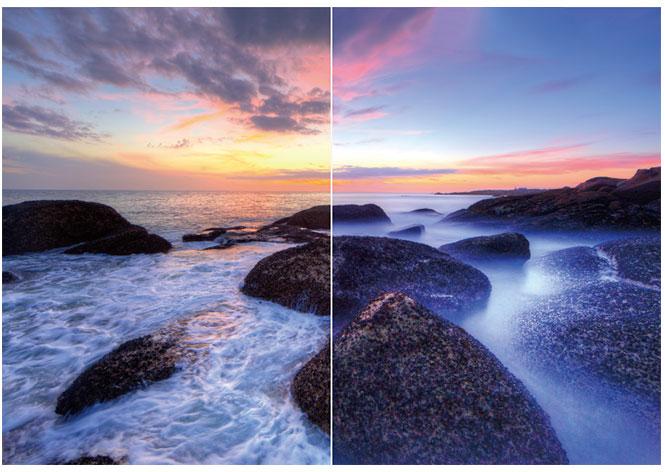
I have a Circular Polarizing Filter and have discovered that it sometimes causes vignetting with my Tamron 17-28mm lens and maybe my other lenses too. I haven't quite isolated it, because I didn't understand what was happening, but I will figure that out soon by looking through my albums for instances of vignetting.
But back to learning and sort of watching my brain figure out a problem...
Issue: Vignetting when using filters
Right now I know I have this vignetting problem and I think it occurs with a combination of my UV filters that I use to protect my lens AND maybe in combination with the addition of the CP filter.
I am now wanting to buy a ND filter and keep feeling like I could find a better filter than the ones I had discovered thus far. I amy also replace my CP filter if it is similarly flawed, but that will take time to figure out.
While shopping I came upon an ND filter that seems to be better than anything I've read about up to this point (and frankly I was becoming discouraged with my progress). This filter is made by Breakthrough Technology. It costs more and I think I understand one of the reasons for this. This filter (linked here) can work with wide angle lens like my 17mm because (and this is the thing I think) this filter is slimmer and fits closer to the end of the lens thus getting "out of the way" of the lens itself. If that's what I understand this filter to do that other filters can't seem to do then this is the filter I want!
UPDATE:
I took my equipment out to shoot fall colors and ALSO to see if I could figure out my vignetting problem. Like is the cause just because I stack two filters together or is there something else going on. I know there is another cause of vignetting having to do with light that enters the lens from an angle... so heading out I set up my tripod and tried to keep everything the same and just change one thing at a time. Like if I am zoomed out all the way to 17mm on my wide angle lens - it the lens "seeing" the stacked filters and that's what is causing the vignetting? Well, one thing led to another and I discovered that I had the wrong lens hood (interchanged) with my other lens.
With all the testing I did I could not force the problem even with stacked filters, different zoom ranges, different lens apertures, or anything else with shooting at the sun or at angles or anything. Maybe the problem is only with my telephoto lens (70-300mm), but at this point I really still don't know because I could not recreate the problem. I don't know, BUT I did fix the lens hood problem. I'm not sure how the hoods got switched up, but I will be aware to prevent that from happening again.
Another discovery is that my sensor during the entire shooting was really dirty! Changing lens gave the same result. What is weird is that the problem reallt showed itself when I had the smallest aperture - maybe that's because of how it focuses or that less light didn't reveal the dirt, but it is weird. I also discovered that my CP filter is scratched and that I have a permanent little crack in UV filter of the 17-28mm lens.
UPDATE to UPDATE:
I decided to get a X4 6-stop ND filter from Breakthrough Technology. I watched reviews, looked over their site and ordered one AND a new X4 CP filter as well. I can use them together to get like an 8-stop light reduction IF stacking isn't a problem for me. I guess I just don't know about the vignetting problem afterall, but I did find a few problems with my equipment that I was able to solve with money.
What I Learned:
- Keep asking questions, never stop learning.
- Read the descriptions and specifications and technical details for products. Sometimes they reveal flaws and limitations or strong points of a product.
- RTFM - the differences between good and great products can be found if you dig deep enough.
- When first using camera, point it at the bright sky, set it to M and change the f/stop to slowest speed like f/22 and see if you can find any objects hanging around. Clean and fix if needed!
- Never assume your equipment is clean or even has the right accessories on it!
- Also never forget if camera is set to APS-C or normal non-cropped mode!!


Comments
Post a Comment